Logistics, food delivery
FindRyd: landmark-based navigation for food delivery riders
Helping riders find the exact door in cities where street addresses don't guide them.
- Product
- FindRyd (Product Leadership Accelerator project)
- My role
- Product Manager
- Focus
- Discovery, problem validation, prototype testing
Context
We started with a broad brief: logistics. Through early discovery, we narrowed it to last-mile delivery, where delays and failed deliveries came up most often and cost businesses the most.
Food delivery stood out within that. Customers expect meals within minutes, platforms run on thin margins, and every late or failed delivery costs them money, ratings and repeat customers.
Problem
As discovery went deeper, our assumptions changed.
- Where deliveries actually break down. We assumed GPS was inaccurate. Riders told us the maps usually got them to the right area. The problem was the final stretch: unmarked streets, inconsistent addresses and buildings that maps don't place well. When riders called customers for help, customers never gave street names. They gave landmarks.
- Who feels the pain and who pays for it. We first assumed riders were our customer. Talking to them showed most would use a better tool but wouldn't pay for one. The platforms carry the cost of late and failed deliveries, so they became our buyer, with riders as users.
My role
I worked as a product manager in a cross-country pod, with teammates in Nigeria, South Africa, Botswana, Mauritius, Uganda, Kenya and Rwanda. I led in-person discovery in Lagos, interviewed stakeholders remotely in other markets, and worked with two podmates on the prototypes.
Discovery
- We spoke with riders, restaurants, last-mile operators and customers who order through food apps like Chowdeck, Glovo, Swoop, Quickli, Mano, Uber Eats and Mr D.
- Food delivery companies we spoke to included Glovo, Swoop, Mr D and Uber Eats.
- This covered Nigeria, South Africa, Uganda, Botswana and Mauritius.
- Navigation came up in every market as a leading cause of delays, though it ranked differently against fuel costs and cancellations.
Key decisions
- Integrate with platforms instead of building a new rider app. Glovo told us riders won't switch apps mid-delivery and asked for something that fits into what they already use. We gave up direct control of the rider experience to reach riders where they already work.
- Hybrid landmark data over pure crowdsourcing. Operations-curated landmarks, checked by one-tap rider feedback. We traded growth speed for accuracy, because a wrong landmark sends a rider to the wrong place.
- Leave out what doesn't test the core idea. We cut WhatsApp pin sharing, in-app calling, weather alerts and offline maps from the MVP. They were useful, but none of them tested whether landmark directions work.
- Start in Lagos. We decided to focus on Lagos because that is where most of our discovery data came from, and we didn't want to spread ourselves too thin by starting in different locations. We'll start small in one place and scale as the need arises.
Prototype and what broke
Our early field test on live Lagos routes showed GPS tracking and arrival detection worked. It also showed landmarks that didn't exist and voice prompts that looped or went silent. We chose to refine, not abandon: fix the landmark data first, then the audio triggers.
Validation so far
- Riders, platforms and customers all described delivery delays as a real cost.
- Glovo spends about ₦100 million a year training riders, and named map reading as a core training need. Glovo asked for a pilot once the product is ready.
- Still unproven: what other platforms will pay to use this, whether landmark data stays accurate as coverage grows, and whether riders change habits in daily use.
Where it is now
After the accelerator, the pod kept building. We're testing with real riders and building our landmark database for Lagos ahead of a pilot. The pilot will measure the share of deliveries that meet the platform's stated delivery estimate, starting from a 40 to 60 percent baseline with a target of 80 percent.
What I learned
The biggest shift wasn't finding a solution. It was letting evidence change who we were building for. Riders felt the problem most, but the platforms paid for it, and that changed how we designed the product.
Screens
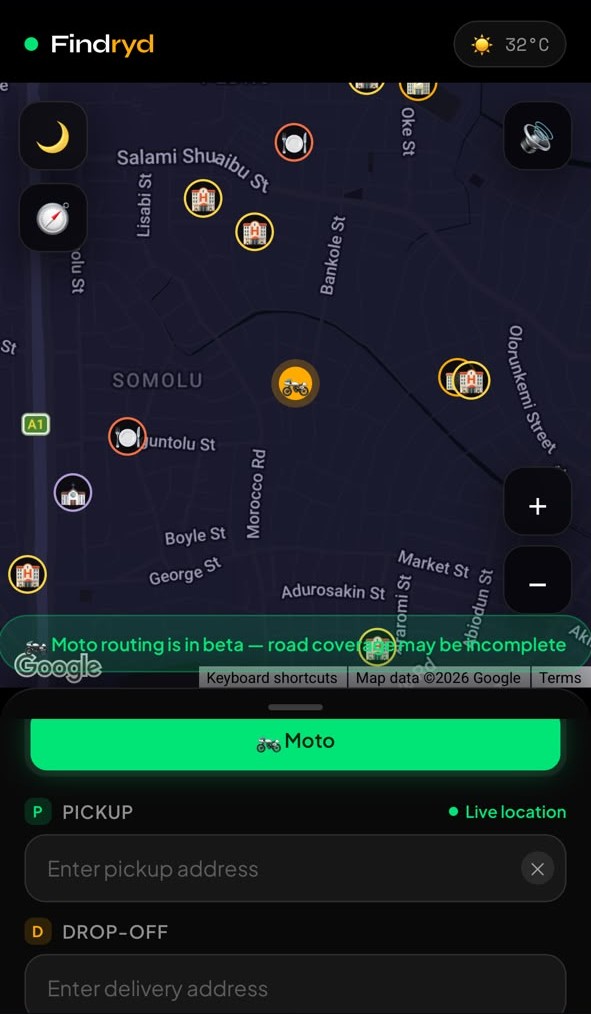
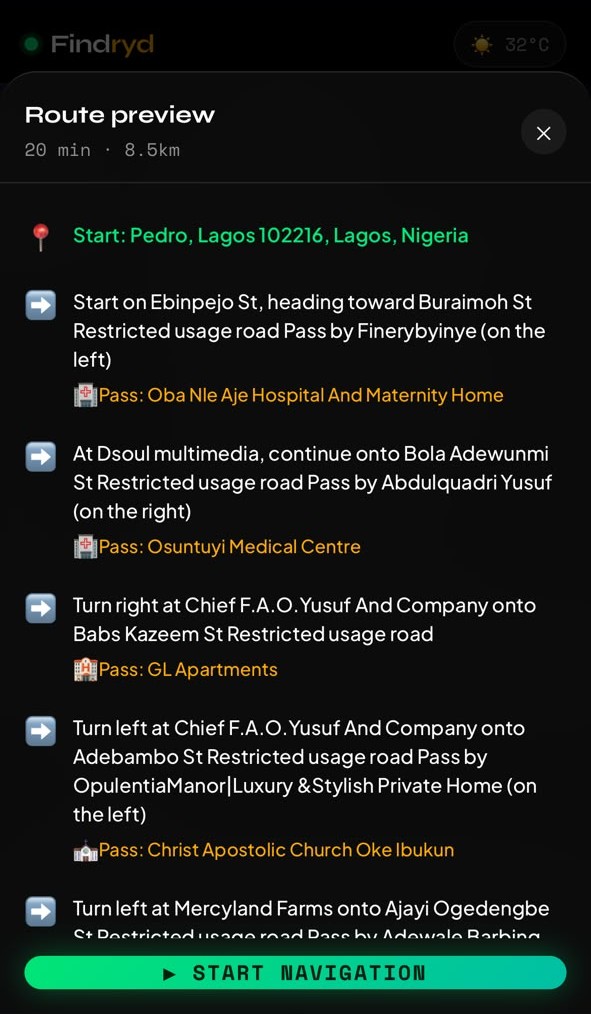
- User discovery
- Problem validation
- Prototype testing
- Stakeholder interviews
- Prioritisation